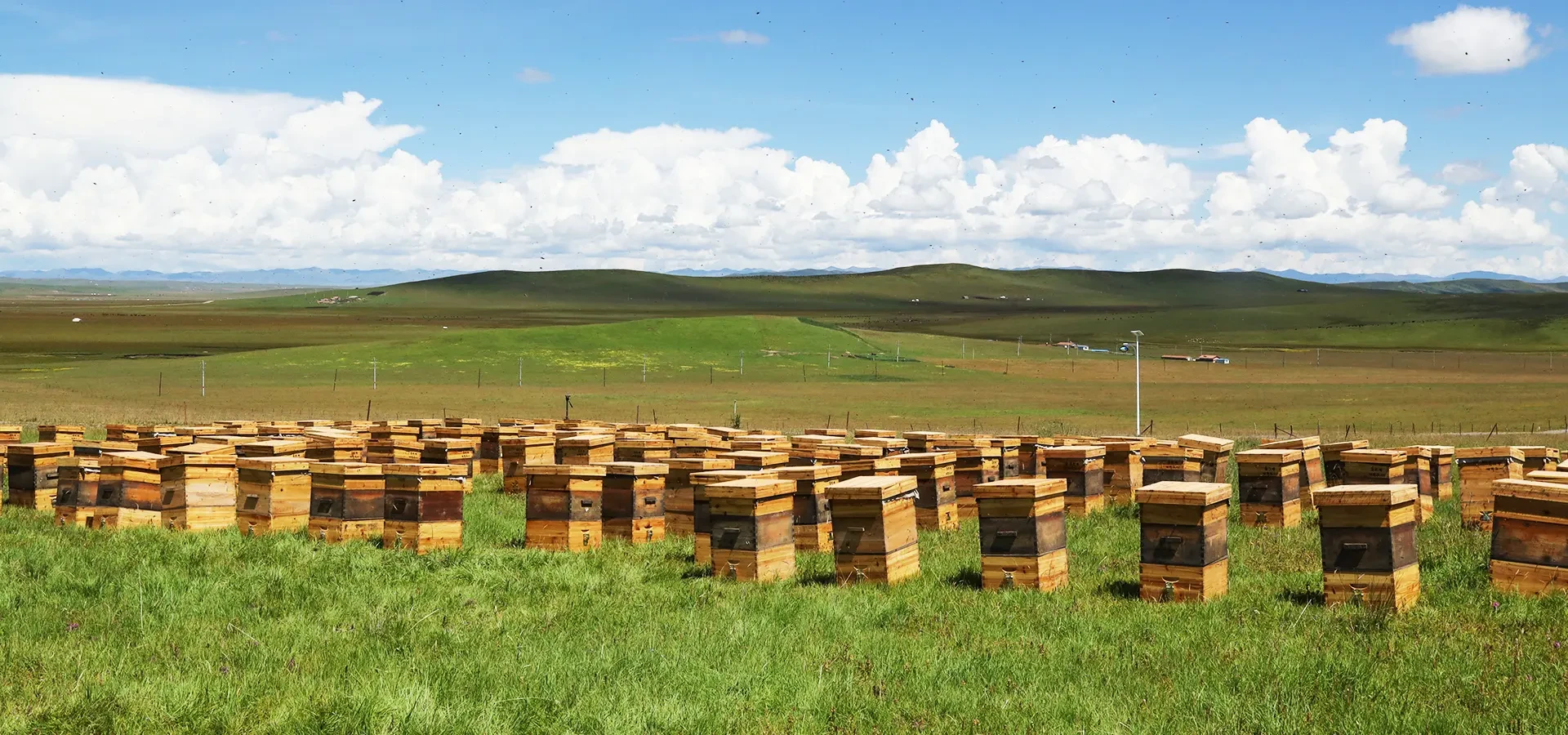
Gansu Wuwei Minqin Fennel Flowering Period Apiary
Honey Source Bases / BASES

Great honey,It's not something you wait for.

Move the hives to where the nectar plants grow. Each of the four zones has its own flowering season and produces unique honey.

Section
Big Four
Self-built base
12 large
Honey variety
12
Annual output
150 tons

Minqin, Wuwei, Gansu: Fennel Flowering Apiary.

02Beehive Stories

12 Bases, 12 Blooming Seasons

NorthwestSection

6base

From the Ertix River Valley in the Altai Mountains to the Qinling Mountains, the Loess Plateau of Longxi, Hexi Oasis, and then to the Ili River Valley and Baluek Mountain, the blooming seasons of the 6 bases in Northwest China are concentrated between 5 and 8. Locust trees, astragalus, fennel, lavender, and wildflowers are the primary nectar sources in this region.

SouthwestSection

3base

The Southwest region comprises the hilly fruit-growing areas of Longquan Mountain in Sichuan, the Kedu River Canyon on the Yunnan-Guizhou Plateau, and the Jiangyou Spring Slurry Base. Loquat blossoms in 11, purple yam flowers in 4, and royal jelly production begins in 3.

Northeast ChinaSection

1base

In the Heilongjiang Wanda Mountain Black Bee Nature Reserve, the pristine forest blooms with linden flowers in 9, and our Purple Linden White Honey is harvested exclusively during this season.

Qinghai-TibetSection

2base

The alpine grasslands in Zeku, Huangnan, Qinghai, sit at an elevation of approximately 3500 meters. Jiangxigou in Hainan Prefecture borders Qinghai Lake. Due to the harsh cold climate, honey and royal jelly are harvested only once every two to three years.

Click the map marker to view base details.

01

Altay, Northern Xinjiang

Altay, Xinjiang: The Ertix River Valley
Deep in the mountains · Bloom period: 6-8

Deep in the Altai Mountains, high latitude, wide temperature swings, and abundant sunlight create ideal conditions. Honey plants grow in vast contiguous patches here, yielding only one harvest per year. Wildflower honey varies slightly each year depending on the blooming flowers—this natural variation is typical for wildflower honey.

Honey plants:Black Goji, Wild Sea Buckthorn, Milk Melon, Bell Thistle

86.8740, 47.7010Navigate here
Altay Mountain Flower HoneyView Product
02

Qinling

Linyou, Shaanxi (Qinling Mountainous Area)
Mountainous forest land · Flowering period: 5 month

The Qinling Mountains, New Zealand's North Island, and Germany's Black Forest are jointly recognized by the industry as the world's three premier golden honey source regions. The 2000 km of wild locust forests bloom in 5, and with their short flowering period and concentrated nectar flow, this is one of the few bases with the shortest harvest window.

Honey plants:Wild Locust (Honey Locust)

107.7960, 34.6780Navigate here
Acacia HoneyView Product
03

Dingxi, Gansu

Dingxi (Longxi), Gansu
Loess Plateau Production Area · Bloom period: 6-7

Dingxi has 35 mu of authentic Astragalus production areas. The flowering season occurs from 6 to 7, with a light honey color and a herbal aroma. Batch 2026 tested at an amylase value of 36.9 mL/(g·h) and proline content of 452.5 mg/kg.

Honey plants:Authentic Astragalus (from 35 mu cultivation area)

104.6340, 35.0030Navigate here
Astragalus HoneyView Product
06

Tacheng, Xinjiang

Balkluk Mountain, Yumin County, Tacheng, Xinjiang
Above 2000 meters · Bloom period: 6-7

Bairuoke Mountain averages over 2000 meters in elevation. The safflower is a unique honey source found only in China here. This honey type is no longer available; the base remains preserved as a historical record of the brand's honey source layout.

Honey plants:Safflower (Honey variety discontinued)

82.9820, 46.2010Navigate here
Safflower Honey (Seasonal Honey)View Product
08

Yunnan-Guizhou Plateau

Xuanwei, Yunnan — Weining, Guizhou: Kedu River Gorge
Above 2000 meters · Flowering period: 4 month

At low latitudes with high altitude, terraces create a unique microclimate. Flowers bloom in 4, and the honey naturally crystallizes into a milky-white, creamy texture that melts instantly upon contact. The moisture content for the 2025 batch is 16.6%, and the diastase value is 21.2 mL/(g·h).

Honey plants:Purple Sweet Potato (Snow Fat Type Honey Source)

104.1040, 26.2190Navigate here
Purple Sweet Potato Snow HoneyView Product
05

Ili, Xinjiang

Huanghuang Village, Huocheng, Ili, Xinjiang (Ili River Valley)
River Valley Flower Belt · Bloom period: 6-7

The Ili River Valley is a major lavender-growing region in China. During the flowering season from 6 to 7, it features honey-toned pale amber with delicate floral notes. The proline content in batches from year 2026 was measured at 718.8 mg/kg.

Honey plants:Lavender

80.8740, 44.0530Navigate here
Lavender HoneyView Product
04

Minqin, Gansu

Minqin, Wuwei, Gansu (Confluence of Badain Jaran and Tengger Deserts)
Oasis Agricultural Area · Bloom period: 6-7

Two deserts converge here; fennel is a drought-resistant crop on the oasis. It blooms in 7, with honey-colored light amber and an intense aroma. The 2026 batch has a diastase value of 48.5 mL/(g·h), one of the highest among available honey varieties.

Honey plants:Fennel

103.0930, 38.6240Navigate here
Fennel HoneyView Product
10

Heilongjiang Wanda Shan

Wanda Mountains (Black Bee Nature Reserve), Luobei County, Hegang, Heilongjiang
pristine forest · Flowering period: 9 month

China's Easternmost Point, a century-old native Linden forest. Linden flowers bloom in 9, producing honey that naturally crystallizes into pure, fine white grains. Batch from 2025 year: diastase value 21.0 mL/(g·h), HMF not detected; factory-tested moisture 16.9%, supporting Brix level 43°.

Honey plants:Century Linden

130.8280, 47.5770Navigate here
Linden HoneyView Product
11

Huangnan, Qinghai

Ze'ek County, Huangnan Tibetan Autonomous Prefecture, Qinghai
Alpine grassland at 3500 meters elevation · Once every two or three years

Gateway to the Qinghai-Tibet Plateau; source of the Yangtze, Yellow, and Mekong rivers. All-organic pastures where Tibetan medicinal herbs grow wild among wildflowers, yielding honey with deep amber tones and rich herbal fragrance. Won the Silver Award at the 2024th Asian Beekeeping Association Congress in year 17.

Honey plants:Medicinal Herbs and Wildflowers of Tibet

101.4660, 35.0360Navigate here
07

Longquan Mountain, Sichuan

Longquan Mountain Range, Chengdu, Sichuan · Longquanyi
Hilly orchard areas · Flowering period: 11 month

Longquanyi is the ancestral home of loquat. Loquat blooms in 11 and is the only base that produces honey during winter. Yield fluctuates significantly year-to-year due to temperature and frost conditions.

Honey plants:Loquat

104.2740, 30.5610Navigate here
Loquat HoneyView Product
09

Jiangyou, Sichuan

Jiangyou, Sichuan (Chunjiang Base)
Hilly farming areas · Sap extraction period: 3 months

First harvest of early spring: the strongest colonies begin propolis secretion. Our base collects using a 48-hour cycle, yielding milky-white propolis with a distinct spicy note. Tests on batches 2026–03 (sample 10-HDA) show 2.11% purity, meeting GB 9697-2008 Grade A standards.

Honey plants:Spring's first honey source

104.7450, 31.7780Navigate here
Fresh Royal Jelly (First Spring Harvest)View Product
12

Hainan Prefecture, Qinghai

Jiangxigou, Hainan Tibetan Autonomous Prefecture, Qinghai (adjacent to Qinghai Lake)
Above 3300 meters · Sap extraction period: 9 months

On the Qinghai Lake Plateau, honeybees produce propolis in low temperatures and under strong UV radiation. The harvesting period is concentrated in 9. It won the Gold Award at the 17 Asian Apiculture Association Conference in 2024.

Honey plants:High-altitude rapeseed and thousands of plant species

100.6200, 36.2840Navigate here
Blue Beehive Royal JellyView Product
03Bloom Period Comparison

When, where, and what honey?

BaseHoney typeFlowering Period / Sap Extraction Period
Linyou, Shaanxi (Qinling)Acacia Honey5 Month
Dingxi, GansuAstragalus Honey6-7
Minqin, Wuwei, GansuFennel Honey6-7
Huocheng, Ili, XinjiangLavender Honey6-7
Altay, XinjiangAltay Mountain Flower Honey6-8
Yumin, Tacheng, XinjiangSafflower Honey (Seasonal)—
Yunnan Xuanwei — Guizhou WeiningPurple Sweet Potato Snow Honey4 Month
Longquanyi, Chengdu, SichuanLoquat Honey11 Month
Jiangyou, SichuanFresh Royal Jelly (First Spring Harvest)Sap extraction period: 3 months
Luobei, Hegang, HeilongjiangLinden Honey9 Month
Zeku, Huangnan, QinghaiHoney9 Month
Jiangxigou, Hainan Prefecture, QinghaiBlue Beehive Royal JellySap extraction period: 9 months

Annual production is approximately 150 tons. Flowering periods vary with the year's climate; actual honey flow depends on base conditions.

04Direct Procurement Model

From honeycomb to jar, in just three steps.

01

End-to-end direct sourcing from self-built bases

Our apiaries are brand-operated. Beekeepers harvest honey according to base standards; we do not source from independent farmers.

Honey harvesting at the apiary.

02

Complete Honey Extraction Process

Honey extraction and filtration are completed at the base, with no heating or refining.

Base Filtering Equipment

03

End-to-end process for raw material aliquot testing

Honey is only repackaged—no processing or blending. It retains its original aroma and crystallization characteristics.

End-to-End Laboratory Testing Workflow

Lyu ICP Bei 16022711 Hao-3